

Ever since humans started stacking rocks to protect themselves and their families from wild beasts and the elements we have been confounded with surviving in a world of stress. Thousands of years ago, the goal was to protect family and friends from the rain, snow and wind. Today, people are beset with a host of new problems to solve. Disease, terrorism, fear, separation and death are the enemies of our time. Stresses in 2012 are mental illness, isolation, hopelessness and heartbreak. A myriad of emotional tragedies splatters the canvas of our lives.
While a host of medical and psychological professionals tackle healing, coping, and recovery methods, Architects as well enlist in the battle for the survival of our souls.
In this conceptual study, Matthew Hofmann, a graduate of the Cal Poly San Luis Obispo School of Architecture, and California licensed Architect, explores the relation of architecture form and human emotion. He transcends the theoretical into the actual by constructing a place of healing.
In the fourth year of his Architecture program, Hofmann studied in Florence, Italy. Millenniums of European culture joined with the natural influences of his own upbringing in California’s majestic Sierra Nevada. Naturally, this led to the creation of a fifth-year project that explores one possible answer to stress – a physical and mental rehabilitation center – a retreat for renewal and restoration of the mind, body and soul.
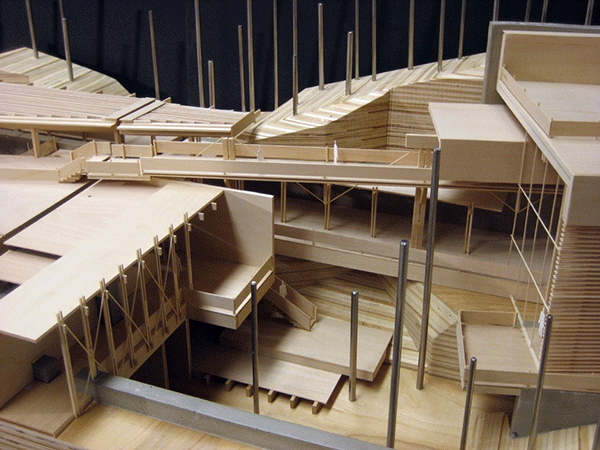
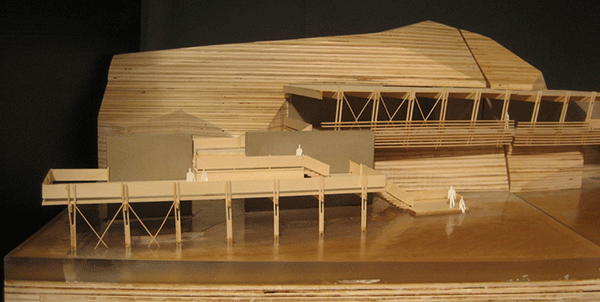
The following abstract is presented in visual form (images of a scale model), along with five Italian words and phrases: TemaForma, CinqueSense, Separzione della Comunità, and Il sito.
Tema
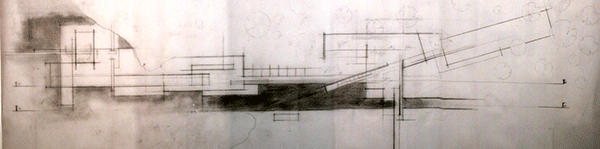
A focused exploration on the relation of architectural form to human emotion as brought about by tragedy or destruction the form of a post-disaster relief project. Exploring a universal model versus a specific site and user. This would encompass a specific focus on a long-term recovery center for both health and mental rehabilitation, with the architecture influenced and intertwined in a natural, rural setting.
Forma
Due to the direct influence of human emotion on this project, it’s equally important for the architecture, both form and context, to speak to and influence emotion, a type of derivation of design from object A but also having design influence the growth and future exploration of object A. Simplicity – a space that distills down the basic aspects of architecture and heightens natural elements causes potential for reflection and introspection.
CinqueSense
The five basic human senses play an extensive role in recovery and rehabilitation. By using the architecture to “tap-in” to each human sensation, relation to form and context is heightened. Making the architecture outwardly passive but fundamentally and actively interactive.
Separazione della Comunità
To what degree does the recovery process encompass the aspect of relation to other individuals? How can one affect the other? A boundary line must be found as described as the “Separation of the community,” and to distinguish between personal and universal space. The ability to separate one’s self from all human contact but have, if almost distant, an emotional foundation to initiate the recovery process.
Il Sito
As mentioned earlier, the site need not be located directly upon the site directly influenced by any given disaster. In fact, perhaps it’s more important to draw individuals away from the site, along with the memories and emotion that encompasses their once existing home. However, the function is not to bury pain and sensation but to aid in the recovery process by providing a space for reflection and internal exploration. Perhaps, to some degree, architectural form should be influenced by many of the basic derivatives of disasters and tragedy, but using these to provide a gradual growth and progression. How can space contribute to the healing process? How does it remind us, and also allow us to forget?
