

Hofmann Architecture started with a hobby for building a tree house, then evolved into world-renown custom Airstream design specialists, and now is a multi-faceted design firm.
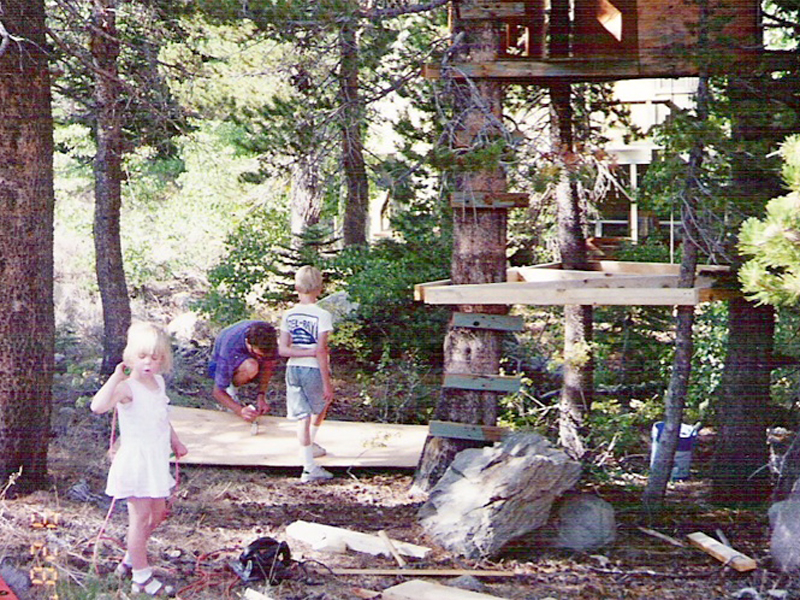
Matthew (age 6) with his sister Allison (4), oversees the design and construction of a 5-story tree house (circa 1988) with his father at their Eastern High Sierra home in Mammoth, CA.
Here’s a conversation with architect Matthew Hofmann.
Q: What is your background? What drew you to architecture as a profession?
A: I was born and raised in the small Eastern High Sierra community of Mammoth Lakes, CA. Perhaps this contributes to my ever-growing wanderlust and fascination with the outdoors. I’ve been passionate about architecture from a very early age. At 6, my father built a small, one room tree house while I stood gazing with a curious eye. By age 12 and with the help of my best friend Marc, I had turned the one room playhouse into a five-story treetop estate. Draw bridges, bunkbeds, a vaulted ceiling, a bathroom with running water (gravity fed cistern high in the tree painted black for hot water), I even had a rope and pulley/child-powered elevator. Looking back, I realize it was at age six that I knew that architecture – creating beautiful spaces – would be a lifelong passion.
Q: Where did you study architecture in school?
A: Between Mammoth and my landing at Santa Barbara, I attended college at Cal Poly SLO, trained in all things architecture. Cal Poly’s motto is Learn by doing – and I believe this is what attracted me to Architecture in the first place. Architecture is a perpetual exercise in making. I’m constantly learning new techniques and meeting new people. As with the treehouse, it’s the process that keeps my attention.
I’m fascinated with the way buildings go together and the unique spaces that people surround themselves with every day. Just as there are no two people alike, every home should be unique as ones own personality. This is what fascinates me.
Although there’s great satisfaction in successfully completing a project, it’s not what motivates me. I prefer to learn new things and move onto the next journey.
Q: How did you get involved with this Airstream project? Is it your personal space?
A: I had been fascinated for several years with Airstreams, maintaining their place as a design icon through the past eight decades. Not exactly knowing the outcome, I rescued the trailer from behind a chain link fence, guarded by a pit-bull, in Mira Loma one dark and rainy California day (foreboding I know). On a whim, I began renovating the trailer over the course of the next six months.
Moving to Santa Barbara in 2006, I worked four years with DesignARC Architects, a wonderful and talented midsized firm. I realized that after this period, I am not suited to working as an employee and decided to venture out to start my own firm. (Hofmann Architecture or HofArc) The Airstream then took on a new meaning for me.
I modeled the interior as a mobile, convertible office space. I realized the Airstream was also a great method for reducing my professional overhead and simplifying my life as I ventured out on my own. I negotiated a space on a piece of ocean view property in Montecito where a home burned down in the recent Tea Fire. For the next year the trailer was my full-time home/office.
The property was stunning and living in a simple space with a close connection to the outdoors was my dream.
The owners were devastated by the fire, but it didn’t stop them. And I enjoy working with clients who are willing to step boldly into the future with gutsy audacity. Events such as the Tea Fire remind us that life’s too short not to overstep the boundaries of the ordinary and dream big. There will be a new home on the lot soon with hardly a trace of the fire. It’s remarkable how quickly nature can recover from such a devastating wildfire.
Q: What were some challenges you ran into while working on a small space? How did it differ from projects you normally work on?
A: The 1978 Tradewind Airstream was 158 square feet of interior space. Designing for life in a small space makes one consider the importance and extreme value of space. Fitting all the necessities of home in the space the size of an average bedroom is an incredible challenge. Multi-use, convertible space became a high priority. A space that serves only one purpose is a waste of space.
I believe that projects can be both large and small. I’m exploring the idea of “fit sizing.” Fit-sized means a lifestyle that is suitably sized correctly for who you truly are, and where you are, at any exact moment in life, like a well-tailored Italian suit.
Q: Living with less appears to be important to you. Why?
A: For me, living with less simply works better. I’ve never been happier. For others, a “fit-sized” home may be five bedrooms, or a combination of the two. I am passionate about designing spaces that are appropriately fit for who those that call it home genuinely are. I find that clients, assisted by architects, end up designing homes that are a result of what they think a house “should” be: influenced by their friends, neighbors, and society.
Working in a small space also taught me that not having the answer to a problem in the immediate moment isn’t necessarily a bad thing. I am teaching myself to let a problem task go unanswered at the end of the day and still be able to sleep at night. Though not always in clear sight, an answer can almost always be reached, or perhaps we’re not asking the right questions. Often times, struggling through a task can lead to creative options that aren’t always visible. Looking externally for answers (through what you don’t know yourself) can lead to more successful solutions – listening is key. The opinion of our friends, family, and coworkers is a valuable asset – the value is in translating and understanding the advice and opinion of others.
Q: What are the advantages to living in a small space like the Airstream?
A: Here are a dozen real life reasons why living in 158 sq. ft. can be a very grand experience.
1. Lower utility bills - serious sustainability
2. Quicker to clean - 30 minutes tops
3. Less maintenance - Say “goodbye” to the chimney sweeper, garage door repairman, and gardener
4. A lot less clutter – I’ve reduced my paper use by 90%
5. Better connected to my girlfriend – the small space encourages us to interact and work out our problems – we no longer have our “caves” or sides of the house to escape to.
6. I’m taking more trips to the farmers market I’m purchasing more fresh fruits and vegetables. No excessive frig/freezer or pantry spaces stuffed with outdated food
7. Discourages procrastination – harder to ignore need-to-do’s when they’re staring right at you)
8. Less stuff gets lost - less places to hide, and when they do, they tend to surface a week later in a shirt pocket
9. Impulse buys – The question when purchasing an item “can I afford it.” Has changed into “can I store it?”
10. Fewer house guests – Thanksgiving is a great time to spend time with your family, and so much better enjoyed when they stay at hotels.
11. Simplified entertainment technology – I sold and no longer own: A dvd player, audio receiver, 7 speaker surround sound, plasma tv, desktop PC, laptop computer, countless remote controls, wireless home speaker system, and portable radio. I then purchased: an IMac.
12. I ended my dysfunctional relationship with Costco. – I realize now that I don’t really need a 5lb bag of peanuts or the treadmill that discourages me from ever leaving the confines of home. Though, I still enjoy accompanying a friend to the mega box store to try the free samples.
