The Road to Reducing - Part One

“I have too much of what I don’t need,” Grampa Hofmann likes to say. He was born in 1927 – a generation known as Depression Babies – and raised during the Great Depression.

Today, there are 40 million Americans of German ancestry. They represent one of the finest collections of diligent workers and disciplined immigrants from Europe. They were farmers, coal miners, and steel workers. They helped build our greatest cities, our highway system, and our financial foundation.

Entering America in the shadow of Lady Liberty through the gates of Ellis Island, they packed, with their meager belongs, practical proverbs filled with common sense and humor. Eighty years later, as Americans deal with the fallout from the Great Recession, there’s a wealth of ironclad advice from the Old Country.

As Grampa says, “A country can be judged by the quality of its proverbs.” When it comes to Germany there is plenty to say. Their words of wisdom are our inheritance.

So, is Grampa right? Do Americans have too much of what they don’t need? What do our overstuffed garages say about us – filled with outdated VCRs, unused exercise equipment, unwanted furniture, and stacks of plastic bins loaded with God-knows-what?

While spending an afternoon knocking back a couple beers and pouring over wise old proverbs with Grampa, I got to wondering what he would suggest… so I asked him. “Do you know any proverbs that speak to living the simple life? How would you help someone reduce?”

Here are 14 German proverbs (translated into English) – along with my thoughts in italics – that can guide you on the road to reducing:

1) A poor person isn’t he who has little, but he who needs a lot.

I’m rich when I’m content with what I have.

2) All beginning is difficult.

I could not experience the joy of being a licensed architect today if I had not embraced the challenge of Calculus in college.

3) God gives, but man must open his hand.

When opportunity knocks I still must open the door.

4) People show their character by what they laugh at.

Grampa’s life speaks to this one – attitude is everything.

5) He who cannot doubt, is a stupid man.

Questioning old ideas often leads to better ones.

6) He who teaches children learns more than they do.

I learn more when I collaborate with others.

7) Envy eats nothing but its own heart.

And it eats creative energy for dessert.

8) Who has never tasted what is bitter does not know what is sweet.

Grampa Hofmann has said more than once, “I’ve loved greatly because I’ve known heartache.” Which is why I put my whole heart into life.

9) Frugality keeps the house.

And overstuffed garages sink it.

10) Money alone doesn’t make one happy.

There are only two types of people – those who have learned this lesson and those who will.

11) Happy is the one who forgets that which cannot be changed.

I don’t worry much about problems I know I can’t fix.

12) Who begins too much accomplishes little.

And the opposite is true: He who starts small accomplishes much.

13) No one is luckier than he who believes in his luck.

It’s important to be good at what you do, but ask anyone who’s won the Lottery or sunk a hole-in-one, it’s important to be lucky, too.

14) Instead of complaining that the rosebush is full of thorns, be happy that the thorn bush has roses.

Look for the good in everything.

A positive attitude is why Grampa Hofmann is alive and spry well into his 80s. It started with he and his family being content “down on the farm” in the Central Valley Heartland of California. “We always had plenty to eat,” he reminisces. “What we couldn’t grow or make ourselves we traded for with a neighbor. What we didn’t have, we didn’t think much about.”

As we finished our time together, he showed me a faded photo as a 4-year-old sitting on his father’s lap in the seat of an old rusted tractor. I noticed he was barefoot.

“That was just the way we lived back then,” he said. “I never realized I was poor until I was six and went to grade school and saw other kids wearing shoes,” he said with a gleam in his eyes. “Before then, I thought all kids went barefoot.”

So, what is enough? What does it look like? And how does one get there? This is just the first leg of our trip. We’ll discuss specific ways to reduce the conjestion in your life in next week’s blog.

Thanks for joining me on the journey.

Living Large in a Tiny Place

The reality of living in 160 sq.ft. Why would anyone choose this?

As seen on the online magazine Tiny House Blog.

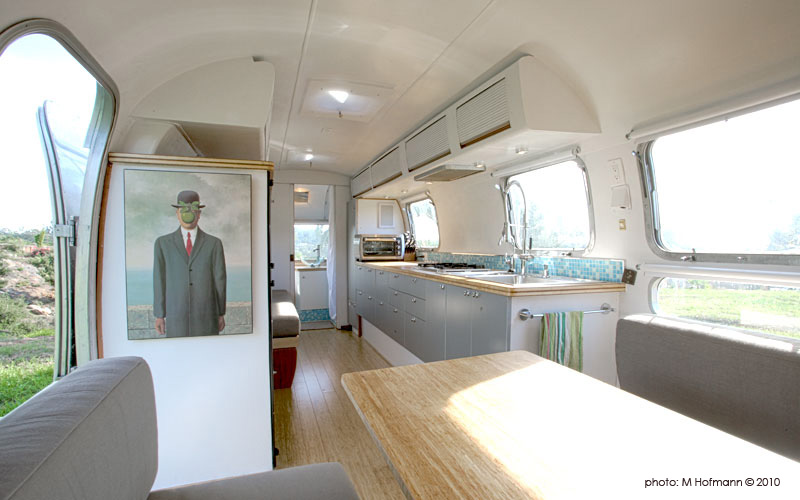
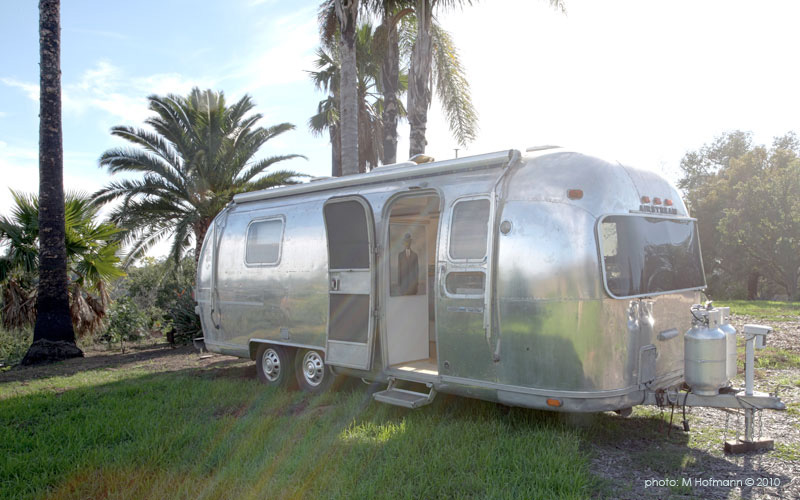
The nostalgic Airstream still gets grins from the gold era of travelers who trekked in Bonnieville station wagons towing their “drag-alongs.” Today, this 1978 Airstream is the home, office and access to the great outdoors for an industrious 27-year old Santa Barbara-based architect.

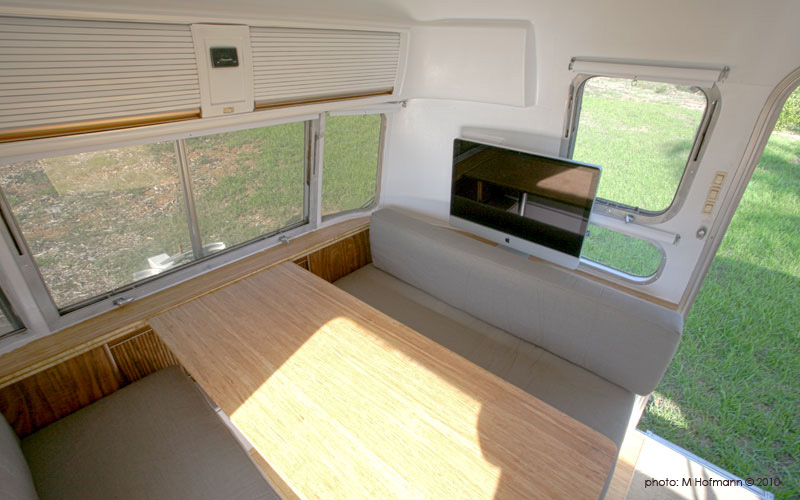
Chances are good that your grandfather owned one of these ubiquitous travel trailers. Except for the iMac mounted on the wall and the hi-def printer in the drawer, they haven’t changed much in the past 75 years.

Airstream’s been around since 1936 when the smooth-skinned aluminum bodies rolled aerodynamically off the Chicago production line. They temporarily stopped production in 1938 when the new lightweight material was needed for World War II. Many are still on the road today.

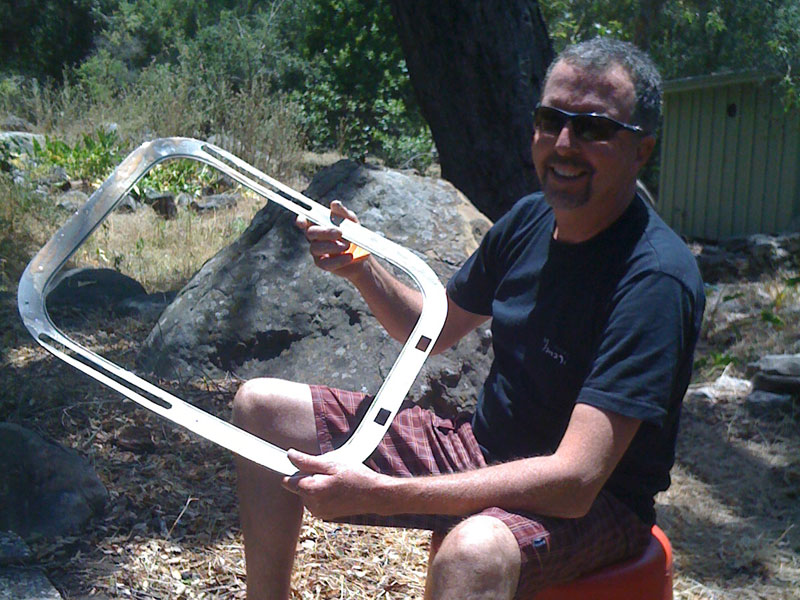
“Ever since I was a kid building 7-story tree houses I’ve liked reusing old stuff and making it usable again,” says its owner Matthew Hofmann, owner and founder of Hofmann Architecture, who spent the past eight months restoring the 25-footer. “It’s not only beautiful, it’s also useful.” “I’m at a point in my life where I’m trying to live with less” says Hofmann, who parked the Airstream on a Montecito home site that burned down in the Tea Fire.

Two years ago I moved from a large house. Moving has a way of making you consider the value of possessions. I wondered, while looking at the massive truckload of things, how would I feel if this truck ran off a cliff and all was lost? My stuff was beginning to feel like a burden, like luggage. Things that I needed to take around with me wherever I went; a truckload sized ball and chain.

Here are a dozen real life reasons why living in 158 sq. ft. can be a very grand experience.

  1. Lower utility bills - serious sustainability
  2. Quicker to clean - 30 minutes tops
  3. Less maintenance - Say “goodbye” to the chimney sweeper, garage door repairman, and gardener
  4. A lot less clutter – I’ve reduced my paper use by 90%
  5. Better connected to my girlfriend – the small space encourages us to interact and work out our problems – we no longer have our “caves” or sides of the house to escape to.
  6. I’m taking more trips to the farmers market I’m purchasing more fresh fruits and vegetables. No excessive frig/freezer or pantry spaces stuffed with outdated food
  7. Discourages procrastination – harder to ignore need-to-do’s when they’re staring right at you)
  8. Less stuff gets lost - less places to hide, and when they do, they tend to surface a week later in a shirt pocket
  9. Impulse buys – The question when purchasing an item “can I afford it.” Has changed into “can I store it?”
  10. Fewer house guests – Thanksgiving is a great time to spend time with your family, and so much better enjoyed when they stay at hotels.
  11. Simplified entertainment technology – I sold and no longer own: A dvd player, audio receiver, 7 speaker surround sound, plasma tv, desktop PC, laptop computer, countless remote controls, wireless home speaker system, and portable radio. I then purchased: an IMac.
  12. I ended my dysfunctional relationship with Costco. – I realize now that I don’t really need a 5lb bag of peanuts or the treadmill that discourages me from ever leaving the confines of home. Though, I still enjoy accompanying a friend to the mega box store to try the free samples.

“I enjoy working with clients who are willing to step boldly into the future with gutsy audacity,” he says. “Events such as the Tea Fire remind us that life’s too short not to overstep the boundaries of the ordinary and dream big.” Matthew Hofmann is available to speak with to answer your questions and currently looking for new thoughtful and progressive architectural clients. Check out their website and blog at www.hofarc.com for more information.

Contact information:
Matthew Hofmann
Architect, LEED Accredited Professional
Hofmann Architecture
[email protected]
www.hofarc.com
805.281.2461


[poll id="4"]

Sustainability and its impact on design

I’m a California licensed Architect (Matthew) who doesn’t think it’s such a good idea to design and build a brand new home. I know, pretty ironic, huh? But sometimes, the most unsustainable thing one can do to the earth is to design and build a new home where there wasn’t one before. Worse yet is tearing down an old home and building a new one in its place.

A new home takes an enormous amount of energy and natural resources to build.

Before one considers new construction, I believe we should think first consider reusing, reclaiming, and recycling.

Like you (I hope!) it’s our job to take care of the earth by our own behavior. This is one of the principles behind our fascination with renovating vintage Airstream trailers — for backyard guesthouses, offices, and even a permanent home.

Using the empty shell – the floor, walls and roof – in an existing building requires significantly less energy than new construction. By eliminating the need for building a foundation, errecting walls, installing windows, and placing on a new roof thousands of dollars of resources that would have been required to build these elements can be transferred, or saved all together.

Take a look around downtown. Many urban city centers have reused old manufacturing plants or storage facilities that were made of brick or concrete, and have remodeled them into attractive residential dwellings. Today, there isn’t a city in America without “urban loft-style” or “in-fill” projects.

Architects today are being challenged to redesign a world as it is broken, and to restore it to be useable, attractive and liveable. This often means working with a world that looks like downtown Detroit and transforming it into a city like Santa Barbara.

My 1978 Airstream project was, at its heart, an exercise in reusing an existing space, and transforming it into a place where I would feel comfortable moving it into a place like Santa Barbara — the city where America’s environmental movement began in 1969 after a horrific oil spill. Today, through the collective action of Americans just like us, Santa Barbara is an example of a much better place.

That’s precisely what we are doing here at HofArc. We are bringing back dilapidated, unwanted piles of metal into a place of relevance, function and beauty.

Airstream Exterior

Remember the 3 R’s when choosing products and materials (reuse, reclaim, recycle)

Once an existing space is chosen, there are often times many existing elements of the previous use that may perhaps be saved and reused for the new project. This category of sustainability can vary greatly.

  • Reuse – to take an existing product and use it for the same function or purpose, this is the most basic and simple method. For example, much of the cabinetry that was existing was saved in the Airstream project. The goucho (bed) was beyond saving, but the storage drawers beneath them made a beautiful base for the new bed. Even the faux wood paneling was reused. The new convertible couch looks like a rich piece of furniture amid the abundance of white walls. The overhead cabinetry was removed, modified, and re-installed to form a more pleasing alignment. All of the overhead cabinetry hardware was saved and reused, including the tambour rollup doors, plastic tracks, and metal pulls. The front dinette set is original, just refinished and painted. All of the original window trim was painted over by several previous owners, the paint was removed and restored to a brushed aluminum finish.

Trim Reuse

  • Reclaim – to use an existing product or material, on-site that may no longer be used for its original intended purpose, removing it and reconditioning as necessary, then transferring it to a new use in the same project. A trailer, by its nature, is a very small confined space. A primary design goal was to open up the space by removing unnecessary visual obstacles. In the Airstream, there were several walls that needed to be removed. The old oak table was beyond repair and was also removed. These elements were stored onsite and reclaimed as shelving in the cabinetry.

  • Recycle – In all projects, there are elements that can not be reused or reclaimed. Instead of sending materials to the landfill, recycle! Recycling comes in all shapes and sizes. Many material scraps from the Airstream were stockpiled and sent to a recycling yard, such as hardware, braces, tracks, rods, plastic paneling, etc. All of the old appliances (refrigerator, oven, sink, toilet) were sold on craigslist or donated to a new user. Giving away or selling old parts that you don’t have a use for has three benefits:

1. It keeps the old part from heading to the landfill;

2. Enables the unwanted item to continue its lifespan in a different use.; and

3. Keeps one less new product from entering the market by providing someone with a working unit. New products = energy + resources.

The beginning…

I kicked off my quest for inner peace at the most logical place – craigslist. I found an Airstream in “fair condition” and a 4-digit deal was struck.

Back in SB with sunny skies!

One dark and stormy night in Mira Loma, I rescued the abandoned rattletrap from behind a chain link fence. My prize was guarded by “a pit bull with an attitude.”

Crap! I recall saying to myself. I’ve just written a sizeable check for what is a glorified dog house. The trailer’s swaying back and forth along rain-soaked 101 like the pendulum of doubt pounding in my brain.

The body was solid, but inside the trailer was a mess. No doubt the last resident was the junkyard dog.

The interior on the day I brought her home. Yes, a vintage carpet of dog fur under every cabinet.

For those who are not familiar with the iconic Airstream and are asking yourselves, “What’s the big deal? It’s a trailer!” Let me share a bit of Americana history with you. There are many things that made America what it was, and still is, today. The VW Bug, muscle cars, Route 66, Elvis, hot dogs, apple pie, and yes the Airstream.

Whether it’s parked or ramblin’ down the road it still gets grins from folks who see this silver bullet. A generation of Golden Era old-timers crisscrossed the country from Mt. Rushmore to Plymouth Rock in their Bonneville station wagons and these “drag-a-longs.”

Maybe one of them was you. Maybe one of them was your parent, or grandparent.

Vintage airstream c. 1944

In 2010, I may be a nostalgic 27-year old Santa Barbara-based modern-design-inclined architect, but this remodeled 1978 Airstream is my home, my office and “front-door-to-the-great-outdoors,” and I love it.

Yes, I have my iMac mounted on the wall and the hi-def printer in the drawer underneath.

So, why did I remodel a 150-square-foot trailer in my spare time while designing $12 million villas by day?

It challenged me, and at this early point in my career I need to be stretched – it’s how I do my best work. Besides, in the business of fresh ideas, this is one that is clearly hitting on all cylinders. It’s efficient, it’s high-tech, and it’s home sweet home.

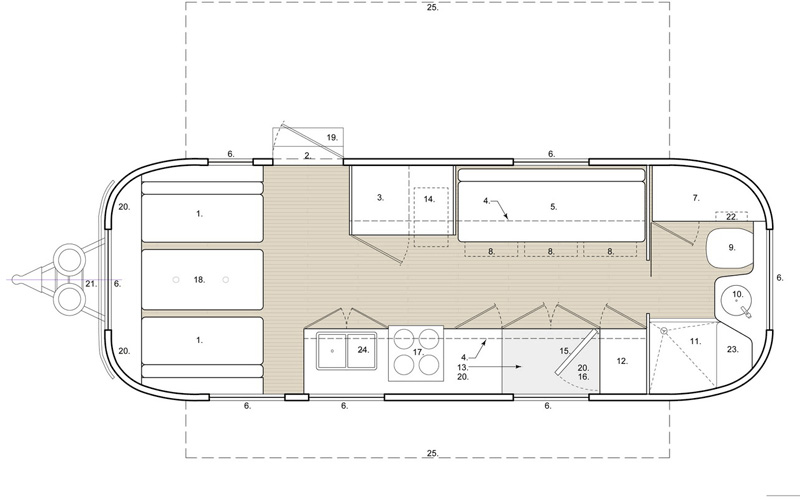
1978 Airstream

  • 25’ Tradewind
  • 160 sq. ft. of livable space
  • Hot water heater
  • Forced air unit
  • Two 10 lb polished propane tanks
  • Two bed, sleeps four comfortably
  • Ample storage areas
  • Electric and sewer hookups

Kitchen

  • Refrigerator (8 cubic feet)
  • Stove (3-burner stove)
  • Toaster oven
  • Over-sized stainless steel sink
  • Reverse-osmosis drinking water

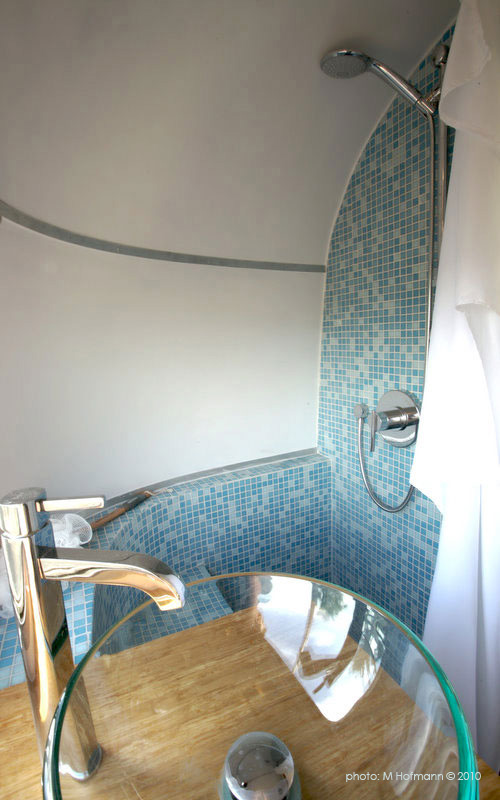
Bathroom

  • Vessel sink
  • Recycled glass tiled shower

AirDream

Ever since I was nine, when I built a seven-story tree house next door to my home in Mammoth Lakes, I’ve been reusing old stuff and making it usable again.

My latest idea was to remodel a 1978, 25-foot Airstream. It’s my office, my home, and quick access to the great outdoors.

It’s also labor-intensive work, but it was worth it. The finished product is not only beautiful, it’s efficient. It’s got everything I need, and nothing I don’t.

A Google search indicates that I’m only one a handful of Airstream DIYers with the chutzpah to pull it off. There are only about a dozen trailer restorers in the US.

Saving money was my primary motivation. I left a 9 to 5 job to start my own architectural design firm HofArc and, naturally, I wanted to reduce my overhead. This was a good way to do it. I have bigger dreams than working in an office all day.

Airstream’s been around since 1936 when these smooth-skinned aluminum bodies rolled aerodynamically off the Chicago production line. They temporarily stopped production in 1938 when the new lightweight material was needed for World War II.

It’s nice to see that many are still on the road today. I smile when I see one — especially one that’s been well-cared for or restored.

It’s about getting an idea on paper then making it real. I guess I’m still a kid who gets a buzz from creating things and seeing them become reality.

…still a kid with big dreams.

In upcoming weekly blogs, I’ll talk about how the restoration process went and continues to go. Come along for the ride.